PRA in Labrador Retrievers: The PRCD Mutation and Breed-Specific Management
Labrador Retrievers are among the most frequently tested breeds for Progressive Retinal Atrophy. Understanding the prcd mutation, its prevalence, and how responsible breeders eliminate affected offspring while preserving outstanding working lines.
Of all the breeds I have followed over two decades of veterinary ophthalmology, Labrador Retrievers present the most striking contrast between the scale of the problem and the completeness of our solution. The prcd mutation — the variant responsible for PRA in Labs — was identified in 2006. Since that moment, producing a PRA-affected Labrador has become entirely optional. Yet cases continue to appear, driven by inadequate testing, misidentified breeds, and the enormous unregulated pet trade.
Understanding why this continues, and what responsible breeders can do differently, requires knowing the biology of prcd-PRA in Labradors and the specific demands of testing in a breed this popular.
The PRCD Gene and Its Role in the Labrador Retina
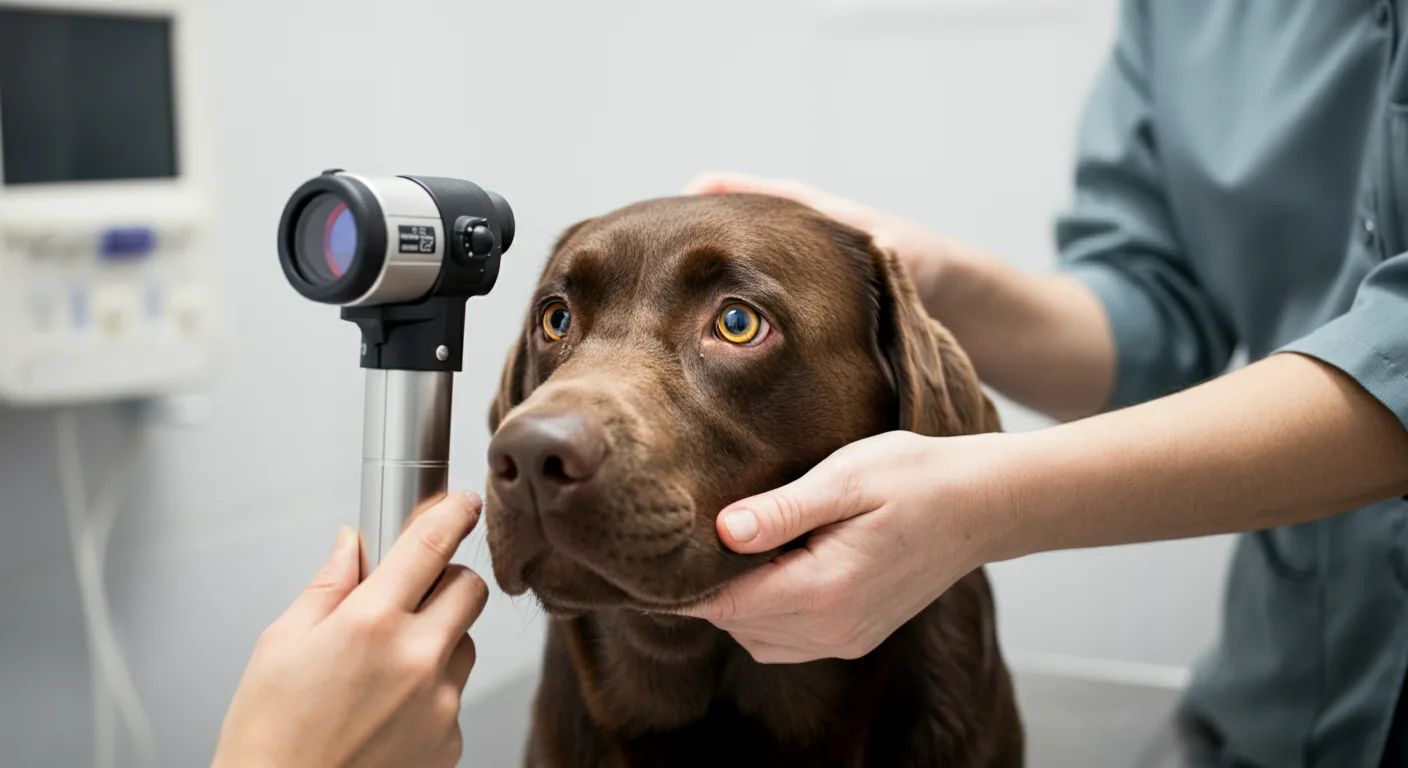
The PRCD gene encodes a small protein found in the outer segment discs of rod and cone photoreceptors. Its precise function remains incompletely understood, but its necessity is unambiguous: dogs carrying two copies of the mutated allele fail to maintain photoreceptor outer segment integrity. Rod cells degenerate first, typically becoming apparent clinically between three and eight years of age depending on the individual, followed by cone degeneration leading to complete blindness.
The mutation is autosomal recessive, meaning a Labrador must inherit one mutated copy from each parent to develop the disease. A dog with one normal and one mutated copy is a carrier — phenotypically normal, visually unaffected, but capable of passing the mutation to offspring. This recessive inheritance pattern is the reason that carrier management allows breeders to preserve valuable genetics while eliminating affected offspring entirely.
Gene: PRCD (progressive rod-cone degeneration)
Mutation type: Missense mutation, c.5G>A (p.Cys2Tyr)
Inheritance: Autosomal recessive
Age of onset: Typically 3–8 years for clinical signs
Affected breeds using same mutation: 29+ including Cockers, Chesapeake Bay Retrievers, Portuguese Water Dogs
Prevalence and Carrier Rates
The Labrador Retriever is among the most popular breeds worldwide, which amplifies both the reach of the mutation and the importance of testing programs. Carrier frequency varies significantly between working lines, show lines, and the unregistered pet population. Studies of tested dogs through major registries suggest carrier rates between 10% and 20% in well-tested breeding populations, with higher rates in unscreened populations.
This carrier frequency is manageable. It means that most clear dogs tested in a responsible program will have a clear-to-carrier mating option among high-quality partners. The genetic diversity of the Labrador breed means that eliminating PRA does not require a bottleneck. Breeders have sufficient choice among tested clear dogs without sacrificing working ability, temperament, or conformation.
Clinical Presentation in Labradors
Affected Labradors typically show their first signs of PRA between three and five years of age, though some cases present later. The first owner-observed symptom is almost invariably night vision failure. Owners notice their normally confident dog hesitating at doorways after dark, bumping into furniture when lights are off, or becoming reluctant to enter dark rooms that posed no previous difficulty.
On ophthalmoscopic examination, early changes include increased tapetal reflectivity and subtle attenuation of the retinal vasculature. As described in detail in our guide on PRA disease progression, these changes advance predictably over months to years. Clinical signs and diagnosis by a veterinary ophthalmologist can confirm the condition and help owners plan appropriate adaptations for their dog's changing needs.
The Complication of Secondary Cataracts
Labrador Retrievers with advanced prcd-PRA frequently develop secondary cataracts as a complication of retinal degeneration. These posterior subcapsular cataracts develop as a consequence of the degenerating retina releasing abnormal metabolic products into the vitreous, which then damage the lens capsule.
Owners sometimes mistake the development of visible cataracts for a separate disease process and hope that cataract surgery might restore vision. Unfortunately, by the time secondary cataracts develop in PRA, the underlying retinal damage is too advanced to benefit from lens removal. The cataracts can, however, cause ocular discomfort in some dogs as they mature, and monitoring for this complication is an important part of ongoing care.
Testing Protocol for Labrador Breeders
For Labrador breeders, the standard of care is clear. Every dog entering a breeding program should be tested for PRCD before any mating. This is not optional for a breed where testing has been available for nearly two decades. Multiple accredited laboratories offer the test through simple cheek swab or blood sample submission.
Test: PRCD-PRA DNA test (cheek swab or blood sample)
Timing: Before first breeding, ideally by 12–18 months
Result categories: Clear (N/N), Carrier (N/M), Affected (M/M)
Breeding rule: Never mate two carriers or mate a carrier to an affected dog
Registry: Submit results to breed club health database
Carriers can be retained in breeding programs and mated to clear partners. All offspring from a carrier-to-clear mating will be either clear or carrier — none will be affected. Offspring intended for breeding should themselves be tested before their first mating, as 50% will have inherited the carrier status.
Choosing a Testing Laboratory
Several laboratories offer PRCD testing for Labradors, and results are generally consistent across accredited providers. When selecting a laboratory, prioritize those that submit results directly to breed health registries and offer genetic counseling support. Our dedicated guide on certified testing laboratories provides detailed information on selecting a provider and understanding the accreditation standards that ensure result accuracy.
The Working Dog Complication
Labrador Retrievers serve as guide dogs, detection dogs, search-and-rescue dogs, and assistance dogs in numbers that dwarf other working breeds. PRA represents a particular catastrophe in working dog contexts: an animal trained at enormous expense over years, bonded deeply with a handler, may be functionally retired as PRA progresses.
Guide dog organizations have been among the most rigorous testing advocates. Many have maintained mandatory PRCD testing programs since shortly after the test became available. Their experience confirms that responsible testing programs, consistently applied, eliminate affected offspring without meaningful impact on the quality or availability of working dogs.
A Note on Imports and Mixed Heritage
Labradors imported from countries with lower testing standards present a particular challenge. Dogs bred without PRCD testing may carry the mutation at higher rates than dogs from well-screened programs. Before incorporating an imported dog into a breeding program, PRCD testing is essential regardless of the dog's country of origin or apparent pedigree quality.
Mixed-breed dogs with significant Labrador heritage may also benefit from PRCD testing if they will be used for breeding or if owners wish to understand their dog's genetic health. The test is breed-validated across all dogs carrying the prcd mutation, which affects the same gene in all susceptible breeds. For detailed information on which other breeds share this mutation, our overview of prcd-PRA across breeds provides comprehensive guidance.
The tools to eliminate PRA from the Labrador breed exist, are widely accessible, and are straightforward to apply. Every affected Labrador born since 2006 represents a preventable outcome. The responsibility lies with breeders to use the available knowledge — and with breed organizations and registries to maintain standards that make testing the norm rather than the exception. For additional context on genetic health programs across working breeds, the Herding Gene encyclopedia provides valuable comparative information.
Dr. Amanda Foster, Veterinary Ophthalmologist