PRA in Poodles: Genetics, Varieties, and Testing Across Toy, Miniature, and Standard Lines
Poodles of all varieties are affected by Progressive Retinal Atrophy. The same PRCD mutation crosses the size varieties, creating both testing challenges and opportunities for breeders managing health across a diverse breed.
The Poodle is formally one breed expressed in three size varieties — Standard, Miniature, and Toy — and the genetics of PRA respect this unity while breeders sometimes do not. The PRCD mutation found in Toy Poodles is the same mutation found in Miniature and Standard Poodles. An affected Toy Poodle and an affected Standard Poodle have genetically identical causes for their progressive blindness. The same DNA test serves all three varieties.
This shared mutation becomes important when breeders cross variety lines, as occasionally occurs in programs producing specific sizes. A carrier from one variety can pass the mutation to offspring registered as a different variety. Testing standards cannot be relaxed for any size category.
Which Poodle Varieties Are Affected?
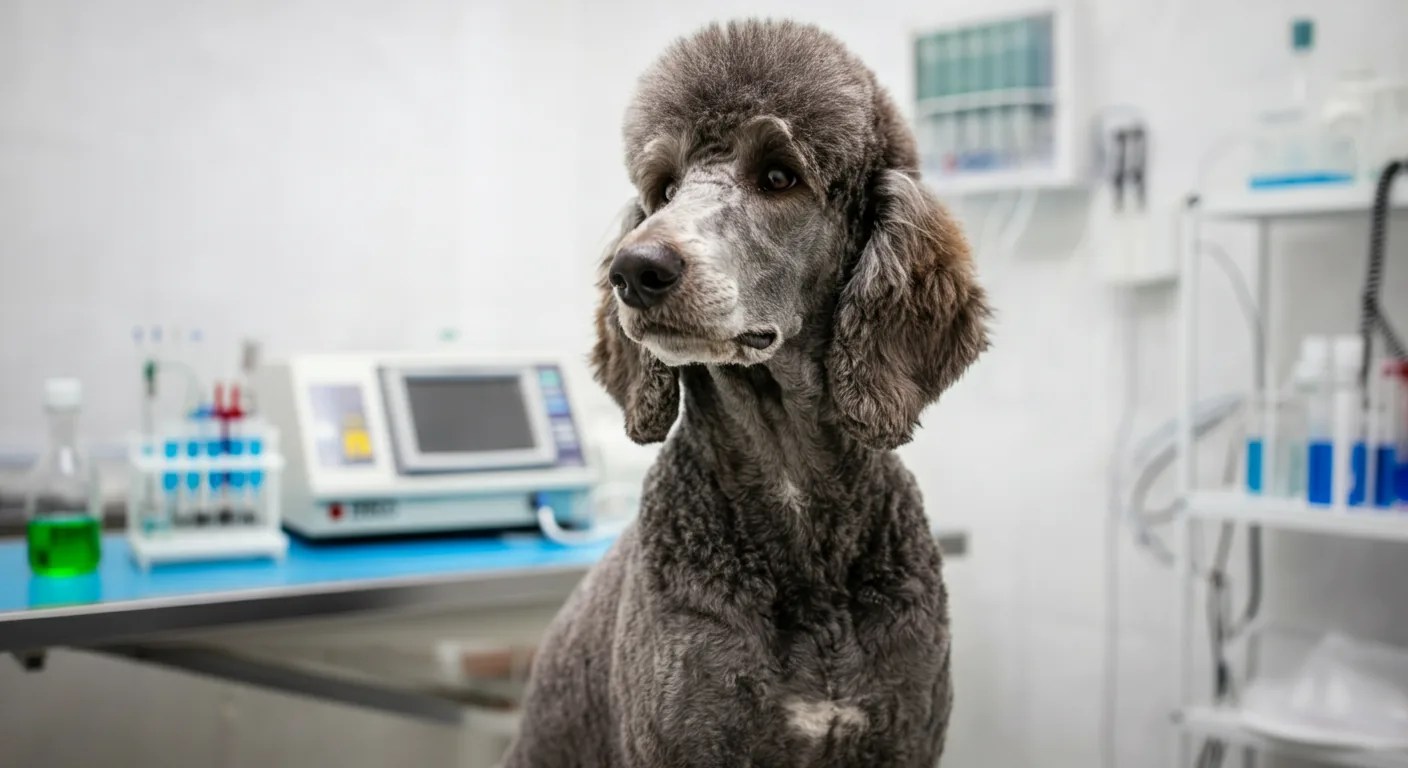
All three Poodle varieties carry the PRCD mutation and can develop prcd-PRA. Studies of carrier frequencies suggest the mutation is present across all varieties, though carrier rates may differ between varieties reflecting historical population differences and breeding practices. Toy Poodles have historically shown higher rates of diagnosis in some surveys, potentially reflecting smaller effective population sizes and founder effects.
Miniature Poodles show moderate carrier rates in well-screened populations. Standard Poodles, with their larger historical gene pool, may have lower carrier frequencies in some breeding lines, but the mutation is unquestionably present and testing remains essential for all three.
All varieties: Test for PRCD
Mutation: c.5G>A (p.Cys2Tyr) — identical across all sizes
Age of onset: Toy 3–5 years; Miniature 3–8 years; Standard 5–10 years
Secondary risk: Secondary cataracts common in advanced cases
Same test for Doodles: PRCD test valid for Poodle-mix offspring
Clinical Presentation by Variety
The clinical signs of prcd-PRA in Poodles follow the characteristic progression seen in all affected breeds: night blindness preceding day vision loss, increasing hesitation in dim conditions, gradual narrowing of the visual field, and eventual complete blindness. As described in our detailed guide on PRA disease progression, the rod photoreceptors degenerate first, explaining why night vision fails before daytime function.
Age of onset varies somewhat across varieties. Toy Poodles tend to show earlier clinical signs, often between three and five years. Miniature Poodles typically present between four and eight years. Standard Poodles may not show detectable changes until five to ten years of age. This variability reflects genetic modifiers and possibly environmental factors, but the underlying mutation is identical across all three presentations.
The Doodle Problem
The dramatic rise in Poodle crosses — Labradoodles, Goldendoodles, Cavapoos, Cockapoos, and dozens of others — has created a new testing challenge. When both parent breeds carry the PRCD mutation, crosses are at risk. A Labradoodle has Labrador and Poodle ancestry, both of which carry the same PRCD mutation. If neither parent was tested, the cross may produce affected offspring.
Reputable Doodle breeders — those who approach their programs with the same rigor as purebred breeders — test both the Poodle and retriever parents for PRCD along with other relevant conditions. The same laboratory test and the same result interpretation apply. A Poodle-crossed-with-Labrador parent that is a carrier for PRCD carries the same risk as a purebred carrier of either parent breed.
Ophthalmoscopic Changes in Poodles
Veterinary ophthalmologists examining Poodles for annual eye certification look for the characteristic changes of early PRA: increased tapetal reflectivity creating a bright, shimmering quality to the tapetal fundus; attenuation of the retinal arterioles giving vessels a thin, wire-like appearance; and pallor of the optic disc as retinal nerve fibers degenerate. These changes develop gradually, and the earliest findings may be subtle enough to require an experienced examiner to identify.
Electroretinography (ERG) can detect functional loss before structural changes are visible ophthalmoscopically. This is particularly relevant for pre-breeding screening of older Poodles where clinical examination results are equivocal. ERG confirms whether the retina is responding normally to light stimuli, providing an objective measure of photoreceptor function independent of subjective examination findings.
Maintaining Genetic Diversity While Eliminating PRA
Poodles, especially Toy and Miniature varieties, have limited effective population sizes. Aggressive carrier culling — removing all carriers from breeding — would disproportionately affect genetic diversity in these smaller populations. The appropriate strategy is to implement strategic carrier breeding: retain carriers with valuable traits, mate them only with tested clear dogs, and test offspring intended for breeding to determine their status.
Over generations, this strategy reduces carrier frequency without eliminating bloodlines. The ethical framework for breeding carriers addresses the tension between disease elimination and genetic diversity maintenance in detail, and the Poodle provides an excellent case study for why simplistic "never breed carriers" recommendations can harm breed health more broadly.
Dachshund-Poodle Crosses and cord1
Breeders working with Dachshund-Poodle crosses (Doxiepoos) should be aware that Miniature Long-haired Dachshunds carry a distinct PRA mutation — cord1 — caused by a variant in the RPGRIP1 gene. This is not the same as PRCD. A cross between a cord1 carrier Dachshund and a PRCD carrier Poodle will not produce affected offspring for either condition, since each parent carries mutations in different genes. But both conditions require monitoring in any subsequent breeding program.
Testing Recommendations for Poodle Breeders
The following minimum standards apply to Poodle breeders committed to PRA prevention:
- Test every dog intended for breeding with an accredited
PRCDlaboratory test before first mating. - Document results and make them accessible through breed club health registries.
- Never mate two carriers. Never mate a carrier to an affected dog.
- Communicate clearly with puppy buyers about parental test results and the small residual risk of untested conditions.
- Test offspring intended for breeding, particularly those from carrier parents.
For detailed guidance on selecting an appropriate laboratory and understanding how to interpret results in the context of your breeding program, our comprehensive review of genetic testing protocols for PRA covers all the essential steps. Additionally, understanding how breed health registries function will help Poodle breeders locate documentation for potential breeding partners and contribute their own test results to the broader knowledge base.
Poodles are intelligent, long-lived companions and working dogs whose quality of life depends on intact vision well into their expected lifespan. The tools to prevent PRA are available, inexpensive relative to the cost of breeding and raising a litter, and simple to use. No Poodle in a responsibly managed program should develop prcd-PRA today.
Dr. Amanda Foster, Veterinary Ophthalmologist