Training Techniques for Dogs Losing Vision: Building Confidence Through Progressive Retinal Atrophy
Dogs affected by PRA can learn and respond to training throughout their vision loss. Adapted techniques using auditory cues, tactile signals, and scent work maintain mental engagement and support confident navigation as sight diminishes.
One of the most common misconceptions I encounter among owners of PRA-affected dogs is the belief that training must stop when vision begins to fail. The logic seems intuitive: training relies on visual signals, visual demonstrations, visual feedback loops. How can a dog who cannot see learn new behaviors?
The reality is almost the opposite. Dogs facing progressive vision loss benefit particularly from continued training because it provides mental stimulation that compensates for reduced environmental interaction, strengthens the communication bond with their handler, and builds the vocabulary of auditory and tactile cues they will rely on as visual information diminishes. Dogs who are well-trained before significant vision loss are substantially better equipped to maintain quality of life through the transition to blindness.
Understanding How Dogs Learn Without Vision
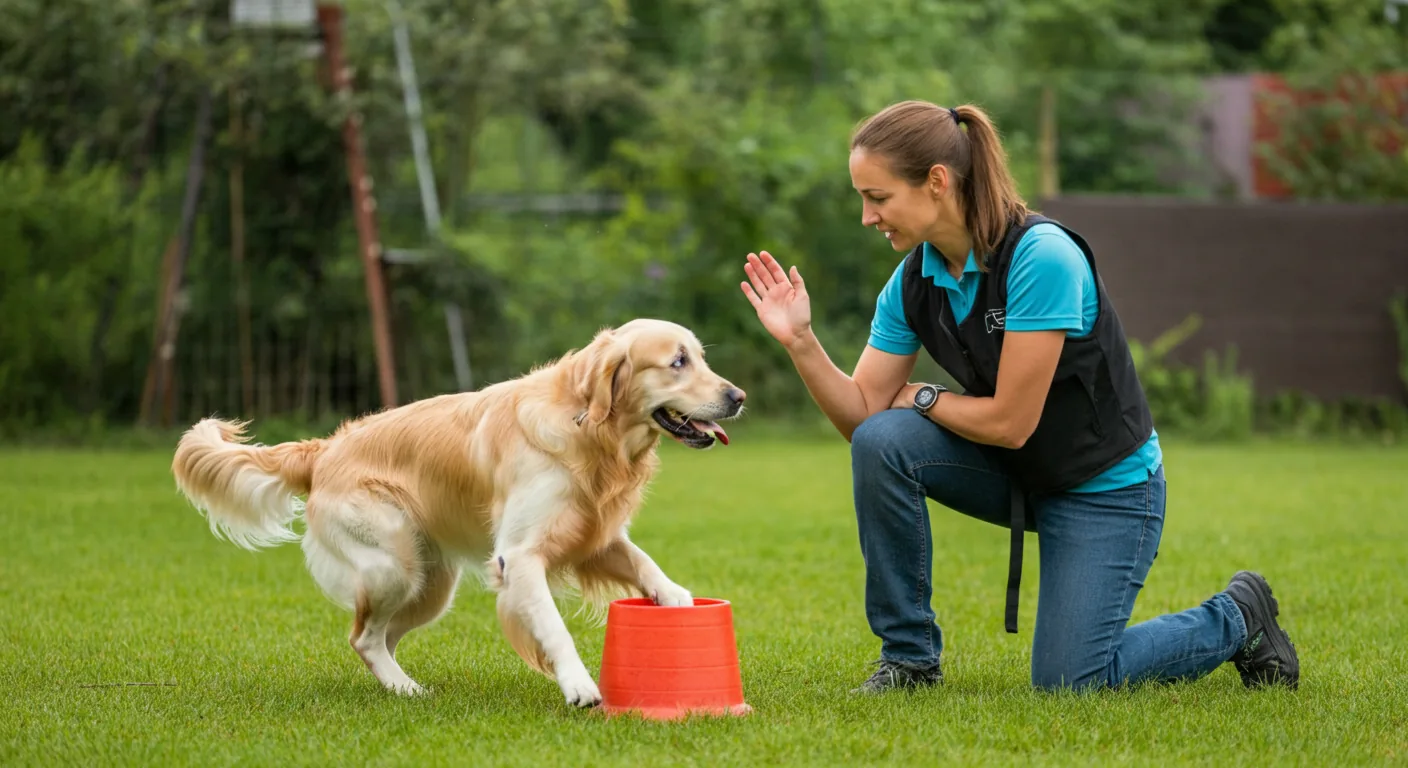
Training does not require vision. It requires the ability to perceive signals, associate them with behaviors, and respond to reinforcement. Dogs with progressive vision loss retain all of these capacities. Their auditory discrimination is typically excellent, their olfactory sensitivity extraordinary, and their tactile sensitivity fully intact. Training that shifts from visual to auditory and tactile signals builds on existing strengths rather than compensating for lost capacity.
The gradual nature of most PRA forms, as detailed in our overview of how PRA progresses over time, actually provides an advantage for training adaptation. Because vision loss is progressive rather than sudden, dogs and handlers have time to build new communication systems while the dog still retains some visual function. The worst adaptation outcomes I observe are in dogs who have not been trained at all before vision fails — they face complete blindness without the behavioral toolkit that trained dogs possess.
Building an Auditory Cue System
The foundation of training for a visually impaired dog is a comprehensive system of auditory cues. This means transitioning all visual hand signals to verbal equivalents — or, for dogs already with verbal cues, ensuring those cues are crisp, consistent, and reliably reinforced without any visual component.
Start this transition early, ideally before significant vision loss has occurred. Add verbal cues to existing hand signals by saying the word consistently immediately before or simultaneously with the visual signal. Over many repetitions, the verbal cue takes on independent meaning. When vision eventually fails, the verbal cue carries the full behavioral weight.
Navigation: "Step up," "Step down," "Watch" (obstacle ahead), "Wait," "This way"
Position: "Sit," "Down," "Stand," "Stay," "Come" (all standard cues, verbal only)
Alerts: "Easy" (slow down), "Find it" (search task), "Get in your bed"
Social: "Good dog" (verbal marker), "All done," "Play time"
See our comprehensive guide on living with a blind dog for the complete communication system.
Tactile Signals and Touch Cues
Touch provides reliable communication that functions regardless of visual status. Many dogs learn to respond well to consistent tactile signals delivered to specific body locations: a tap on the right shoulder for turn right, a tap on the left for turn left, gentle upward pressure under the chin for head up, stroking down the back as a settle signal.
Introduce touch cues systematically, pairing each touch with its meaning through positive reinforcement exactly as you would introduce any new cue. Dogs with PRA retain the ability to discriminate between different types of touch and learn to respond to specific touch patterns with consistent behaviors.
The transition from guide leash to guiding hand, and eventually to a short handle harness for direct guidance, can be taught progressively. Start by walking with your hand resting lightly on the dog's shoulder blade, gradually increasing the guidance information provided through this contact. Dogs who learn this contact guidance feel more secure navigating novel environments.
Scent Work: Leveraging the Strongest Sense
Nose work and scent-based games provide some of the most valuable enrichment for PRA-affected dogs. Searching for hidden food items, identifying specific scent targets, or following scent trails tap into the dog's extraordinary olfactory capacity — a system entirely unaffected by vision loss.
Formal nose work training can begin at any age and continues productively regardless of vision status. The sport involves teaching dogs to find specific odors (birch, anise, clove in competitive nose work) in containers, interior spaces, exterior environments, and vehicles. All search tasks are performed primarily through olfaction, and the same high-drive search motivation that makes nose work excellent for sighted dogs makes it particularly appropriate for vision-impaired dogs.
Informally, hiding treats around the house or yard for a "find it" game provides similar benefits without the formal competition structure. Scent feeding — presenting meals in ways that require searching rather than finding food in a stationary bowl — extends mealtimes and provides enrichment that the environmental adaptations approach uses throughout the home environment.
Maintaining Existing Training During Vision Loss
Dogs trained in obedience, rally, agility, or working roles should not have their training discontinued when PRA is diagnosed. Instead, adapt the training environment and methods to accommodate the current visual capacity.
For obedience and rally, the transition from visual to auditory cues is straightforward and many exercises remain fully accessible. Competition rules in most countries accommodate dogs with disabilities including vision impairment.
Agility requires more significant modification. As vision decreases, contact obstacles may need repositioning for predictable approach, jumps may be lowered, and tunnels may become preferable to open obstacles. Some handlers continue modified agility in private settings long after competitive retirement, providing the physical activity and handler interaction that agility-trained dogs enjoy.
Working dogs — detection dogs, scent discrimination competitors, water retrievers — often adapt their roles remarkably well. A retriever who has learned to trust handler direction and hunt by scent can continue work long after visual marking of falls becomes unreliable.
Training for Specific Challenges
Navigation Training
Teaching dogs to navigate specific environments systematically helps them build mental maps. Walk the dog on leash through the home on consistent routes, allowing them to pause and sniff, providing verbal cues at each landmark (the turn from hallway to kitchen, the approach to the food bowl, the location of the dog door). Repeat the routes consistently until the dog moves through them with decreasing leash guidance. Gradual extension of independent navigation reduces reliance on constant handler direction.
Recall and Orientation
A reliable recall becomes even more critical for a vision-impaired dog. Ensure recall is paired with a consistent sound marker — a specific word, a whistle, a hand clap — that the dog can orient toward. In outdoor environments, a strong recall returns a confused or disoriented dog to safety. Regular recall reinforcement should be maintained throughout life, not treated as already trained and no longer needing attention.
New Environment Protocols
Teach a consistent protocol for exploring new environments. Allow the dog to investigate on a short leash while you provide verbal orientation: "Here's a step down," "There's a wall on your left," "Wide open space here." Over time, dogs develop their own strategies for rapid environmental mapping when handled consistently during explorations.
The Emotional Dimension of Continued Training
Beyond the practical benefits, continued training during PRA progression provides something profound: evidence that the relationship with the handler remains active, responsive, and rewarding. Dogs facing vision loss who continue to train show handlers that their mental capacity is intact, their motivation is present, and their ability to learn is undiminished.
For owners managing the grief of watching a beloved dog lose sight — a process addressed in our guide on coping with a PRA diagnosis emotionally — continued training provides a powerful antidote to helplessness. Instead of watching vision fail, the owner can direct that energy into building a new communication system, developing new skills, and demonstrating through action that blindness is not the end of the dog's active, engaged life.
The dogs who navigate blindness most successfully are, in my experience, trained dogs. Not because training prevents the vision loss, but because training gives them the tools and the confidence to face it. The blind dog who sits when asked, finds treats by nose, heels reliably on a loose leash, and settles on cue is a dog whose world, though darker than before, remains predictable, safe, and full of interaction worth having.
Dr. Amanda Foster, Veterinary Ophthalmologist